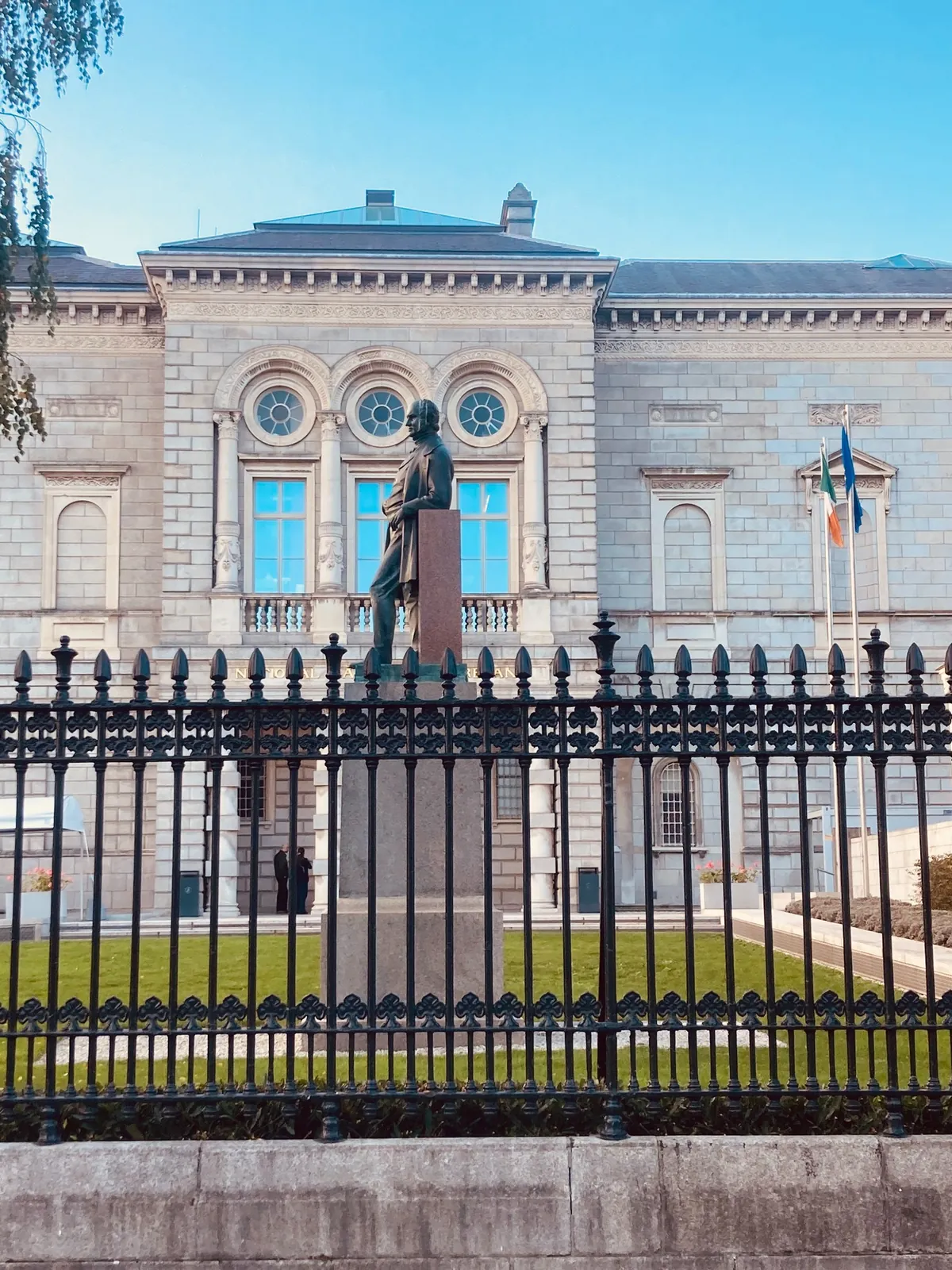
Being from Dublin, a place that I love to visit when I can is the National Gallery of Ireland, a beautiful building with a really impressive collection of Irish and European paintings dating from the Middle Ages through to modern works. Located beside Merrion Square Park and Government Buildings, it is one of the best free things to do when you are in Dublin, especially if you enjoy learning about art, history and architecture.
This is a guide to how to spend an afternoon walking through the many different sections of the gallery, starting off with Impressionist and modern European paintings in the Millennium Wing (beside the Clare Street entrance), before moving through the Irish collections and finishing by viewing some of the gallery's best-known paintings by esteemed artists like Rembrandt, Vermeer, Velázquez and Caravaggio.
The gallery route
Starting at Merrion Square and Walking Around to Clare Street
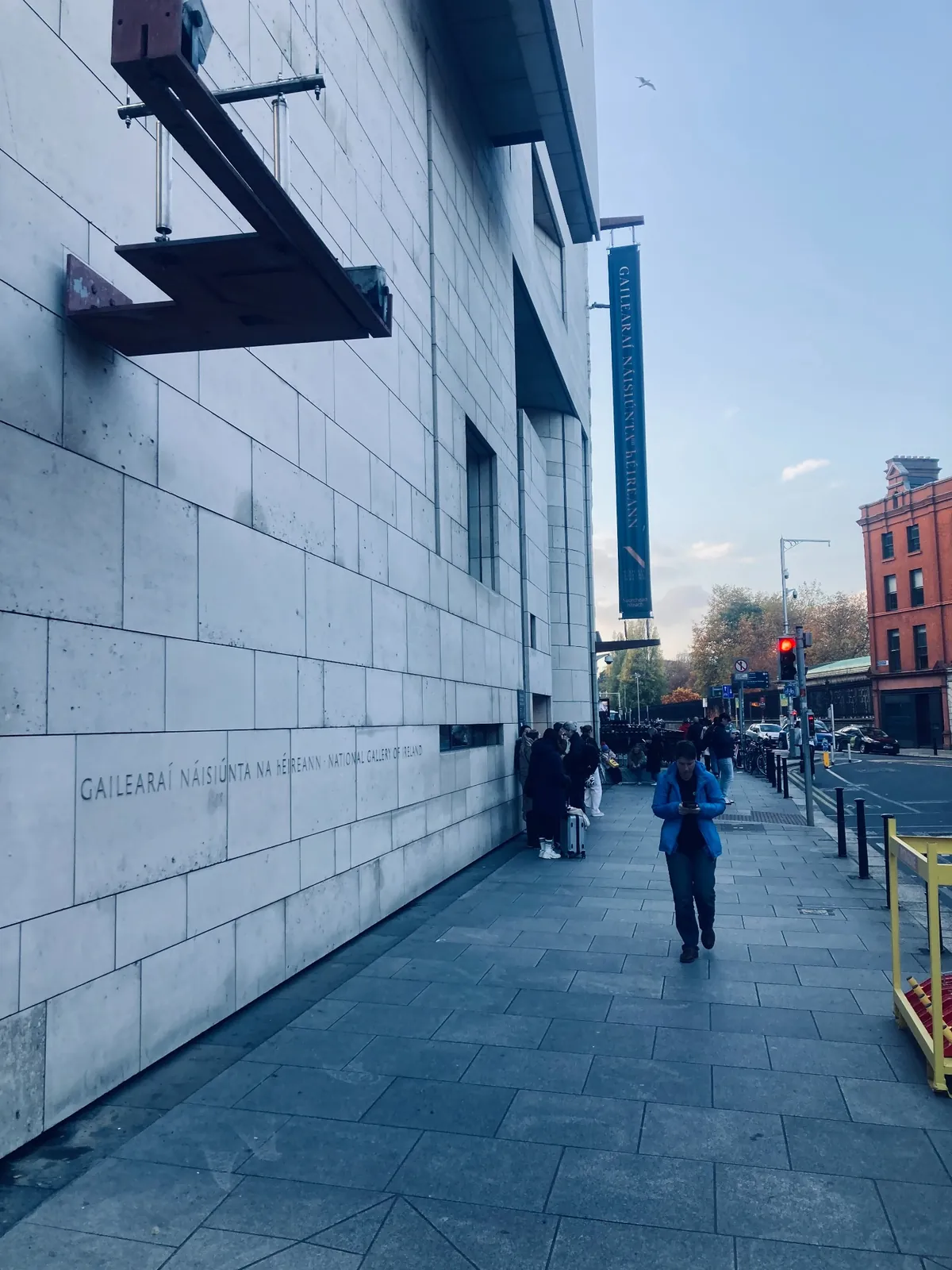
You can choose to enter the building through the original entrance on Merrion Square West, where there is an impressive nineteenth-century façade overlooking the square and a statue of William Dargan, who helped establish the gallery, or you can walk around the side and enter through the smaller Clare Street entrance housing the much newer Millennium Wing designed by Benson & Forsyth and opened in 2002. My suggestion is to enter through Merrion Square if you have belongings to store in the cloakroom, but enter through Clare Street for convenience.
The gallery route
Inside the Millennium Wing
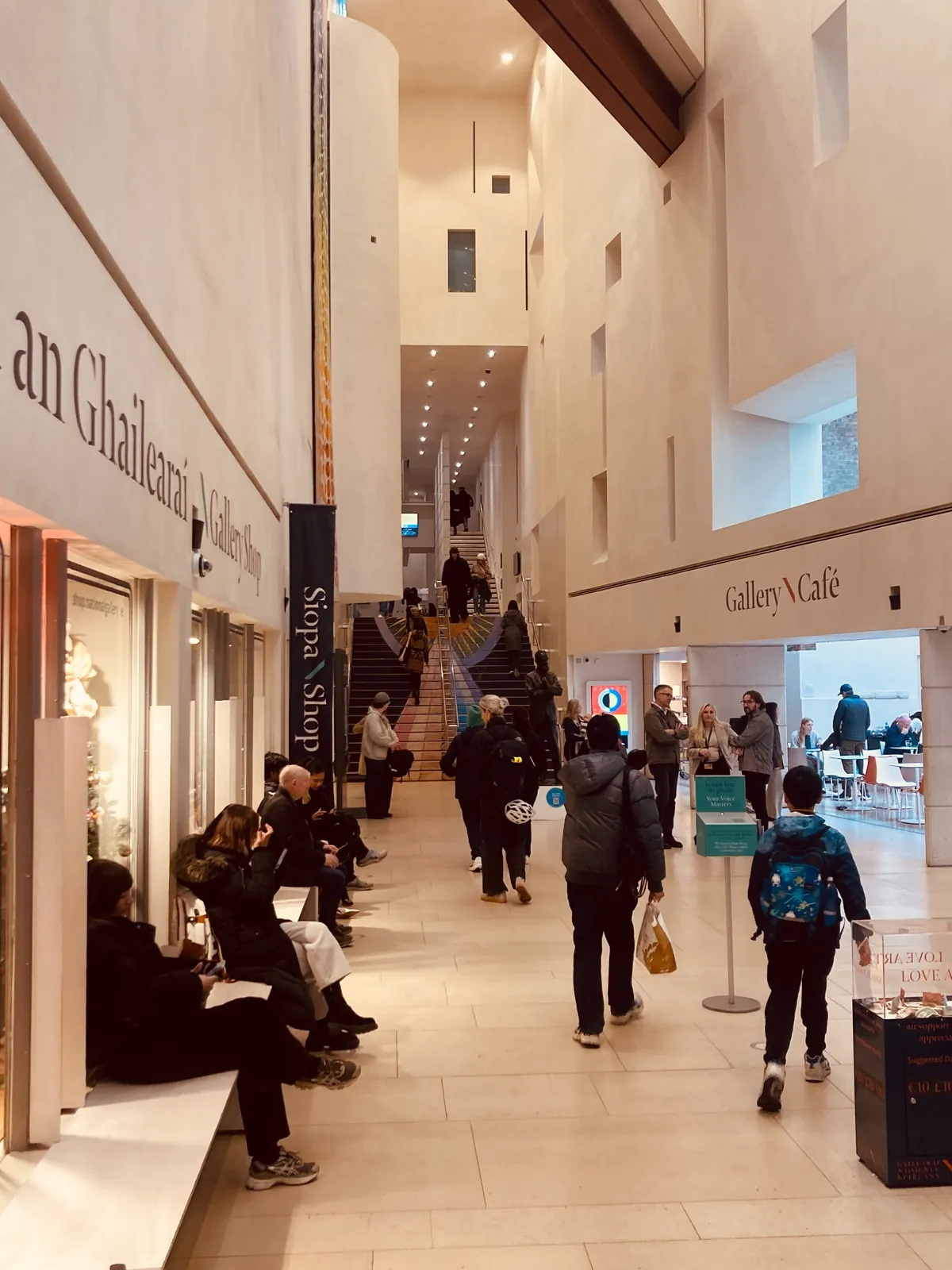
If you enter from Clare Street, you arrive in the main entrance hall. The Gallery Shop is on your left, reception is on the right and the Gallery Café is further on to the right. The gallery is free except for some temporary exhibitions so you can just walk in. The Gallery Shop sells a selection of books, prints, postcards and gifts, many of which are based on paintings in the collection, and is a good place to finish your visit after stopping in the café for a coffee or something to eat. There is a staircase leading to the galleries or if you have limited mobility there is a lift to the left as you walk in.
The gallery route
European Art from 1850 to 1950 – Monet and Modern Painting
As you get to the top of the stairs, you can turn immediately to your left, and the first few rooms (1–5) contain a really interesting collection of nineteenth- and twentieth-century European art, a time when artists began moving away from traditional academic painting and experimenting with new techniques, particularly in their use of colour and light, for example Impressionism.
One of the highlights of this section is Claude Monet's Argenteuil Basin with a Single Sailboat, painted in 1874, which is in Room 3 as you walk through. This painting depicts a small sailing boat on the River Seine at Argenteuil, a town just outside Paris where Monet lived for several years, and the colouring is beautiful with shades of blue reflecting the sky and the orange and brown autumn trees along the riverbank.
There are several other interesting works in these rooms, showing the development of modern painting, including by renowned artists like Cézanne, Renoir, Roderic O’Conor and Pierre Bonnard, to name a few, and the relatively small size of this exhibition space (along with the quality of works on show), makes it a really good first stop on your tour.
Tip: Many of the artworks in the collection are not allowed to be photographed as they are still under copyright or are on loan from private collectors. You can check this by reading the blurb beside each painting and seeing if there is a no-camera sign at the bottom right. You can photograph artworks that are out of copyright, unless otherwise restricted; check the Gallery’s current photography policy for permitted uses.
The gallery route
The Millennium Wing Studio and Exhibition Galleries
As you exit the European Art exhibition, across from you is the Millennium Wing Studio, which is sometimes used for smaller exhibitions by aspiring and new artists, and is worth a quick look if there is an event on. Beside you there are also larger temporary exhibition spaces, which generally require a ticket. At the time of my visit, these spaces were showing Hilma af Klint: Artist and Visionary (15 October 2026 to 7 February 2027), an exhibition by Hilma af Klint, a visionary and radical Swedish painter from the early 20th century known for her works including The Swan and the monumental Altarpieces.
The gallery route
The Milltown Wing and the Irish Art Collection
As you continue on, you have toilets on your left, and then you walk left into a space called the Atrium which has access to the Print Gallery (up the stairs), or the Irish art wing through a door to the right. I would recommend walking through the cloakroom area to the main reception area and turning right, so you can access the Irish art rooms from the main door. All of these areas are fully refurbished with upgrade work by award-winning architects Heneghan Peng improving the facilities substantially between 2011 and 2017. My brother was involved in this work, so I have a nice personal connection to that!
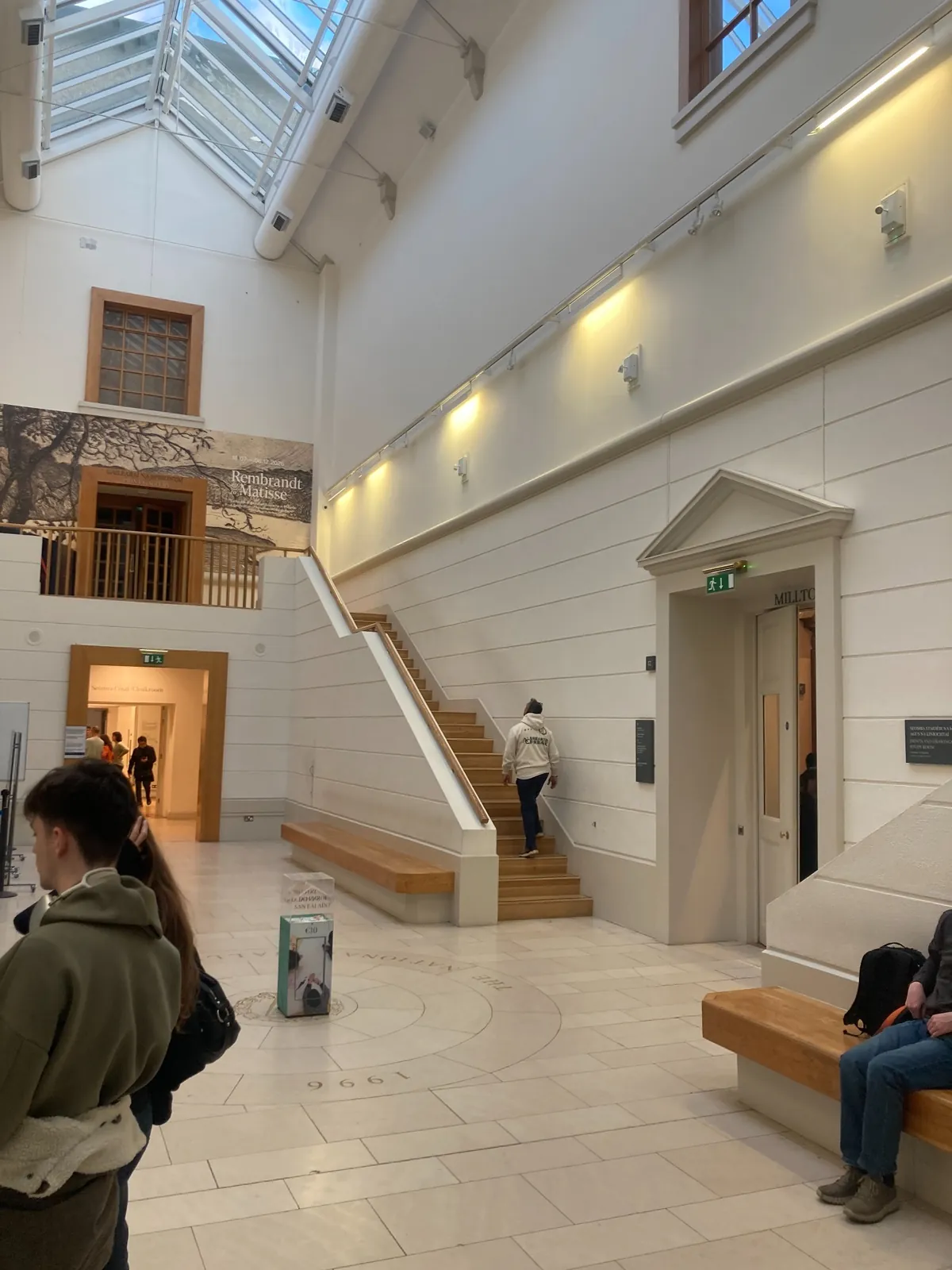
You then enter into the Milltown Wing Irish art rooms. This is named after the Countess of Milltown, who donated an important collection of paintings, furniture and decorative objects to the gallery. In the first room you see works by one of Ireland’s best-known artists, Jack B. Yeats, the younger brother of the Irish poet William Butler Yeats. An artwork to look out for on the right as you enter is one of his most famous paintings, The Liffey Swim, which captures the excitement of a swimming race in Dublin's River Liffey. As you continue down these rooms you can see works by famous Irish artists like John Lavery, Walter Osborne, Roderic O'Conor, William Orpen and Seán Keating, with many of the artworks referencing Ireland’s fight for independence, colonialism and the influence of the Catholic Church at that time during the 1800s and 1900s.
The gallery route
Irish Stained Glass
As you turn left at the bottom of the rooms, you walk into a stunning dimly lit room where a collection of Irish stained glass is shown. Among the best-known Irish stained-glass artists in the room is Harry Clarke, who was famous for his incredibly detailed figures and rich colours, and one of his works in the room, The Mother of Sorrows, is an example of his remarkable use of colour and detail.
You can either continue to walk through into the next room which is Irish landscapes, but I generally walk back a room or two, and exit through the internal door into the Courtyard, which features a beautiful sculpture called Magnus Modus (2017) by Irish artist and designer Joseph Walsh, and is a lovely relaxing space with benches to the side and a high ceiling with glass skylights.
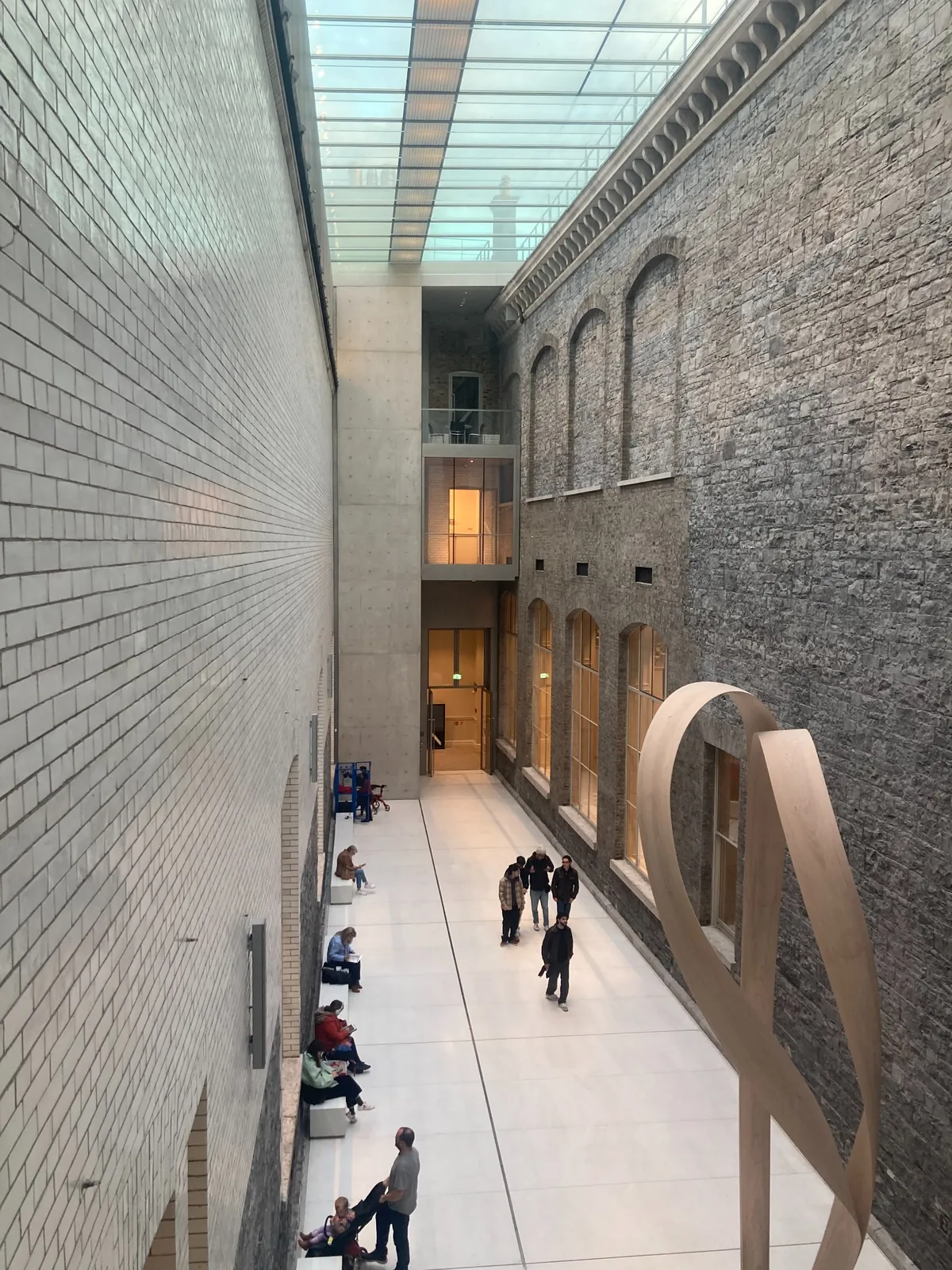
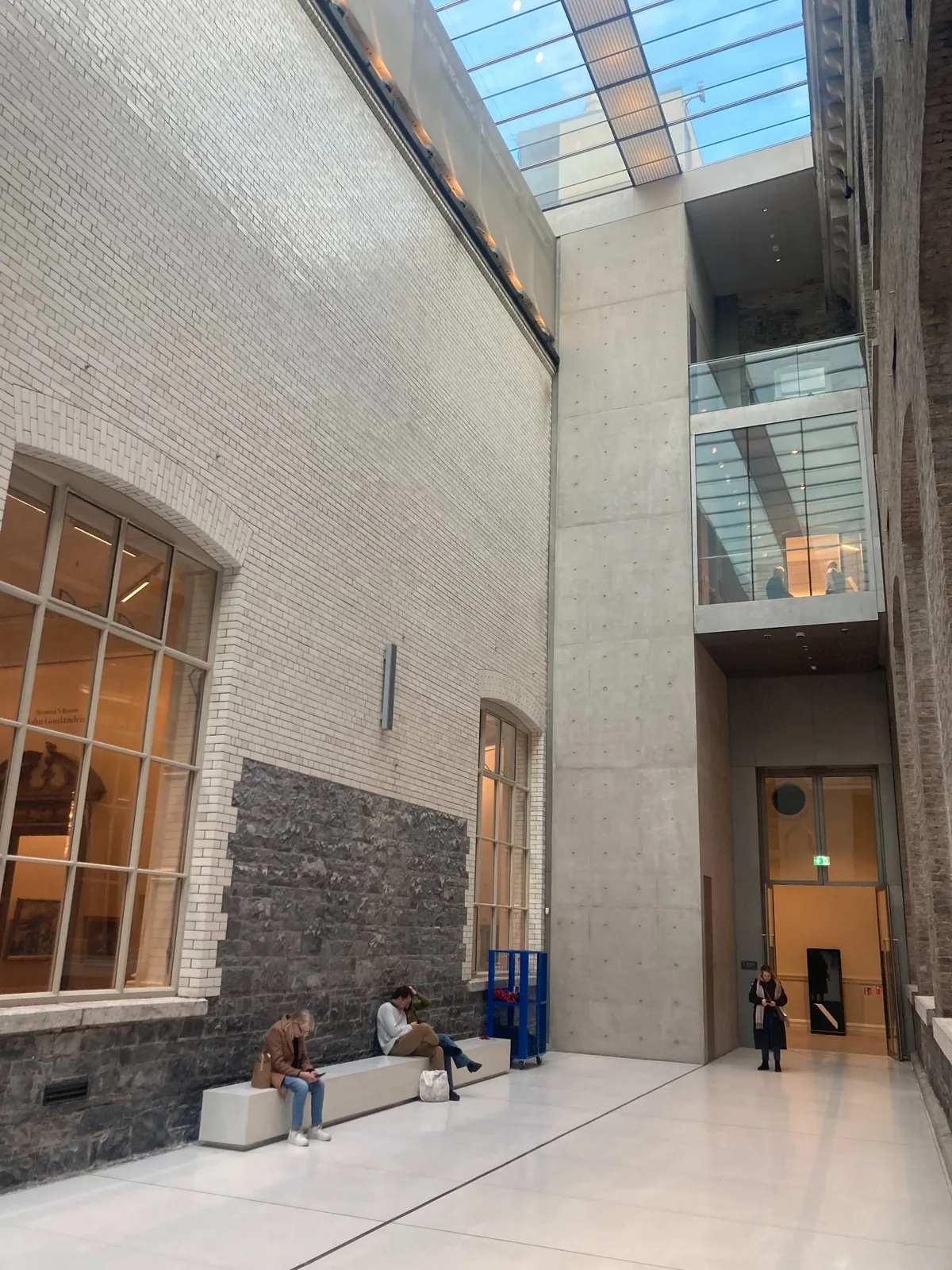
You can either choose to exit at the top of this room and turn right into the Dargan Wing (with a room of Irish gentry portraits in the Shaw room and the Irish portrait collection), or you can take the lift up to the third floor to the main galleries (which I did). If you are in the Shaw Room, you will see a very famous artwork called The Marriage of Strongbow and Aoife by Daniel Maclise, which is a monumental, wall-sized masterpiece that depicts the pivotal moment in 1170 when the Norman presence in Ireland was strengthened, and one of Ireland’s most famous paintings. One room also well worth seeing in the Dargan Wing is the Grand Gallery (Room 44), a magnificent, top-lit hall featuring rich green walls, a soaring glass ceiling, and central benches accessed by climbing a few steps from the adjacent Shaw Room, and it is full of portraits of battles, Anglo-Irish aristocracy and portraits of prominent families from the time.
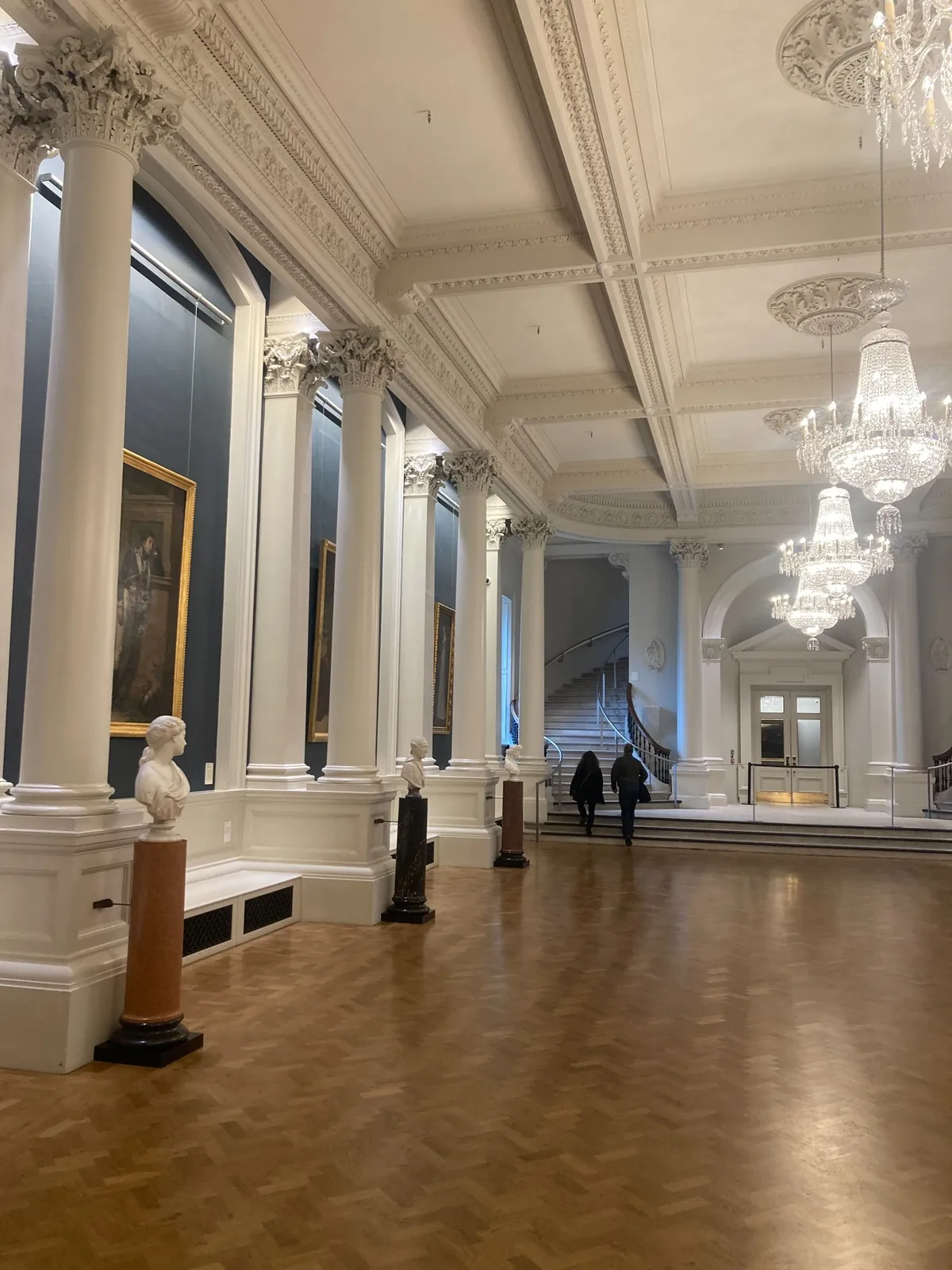
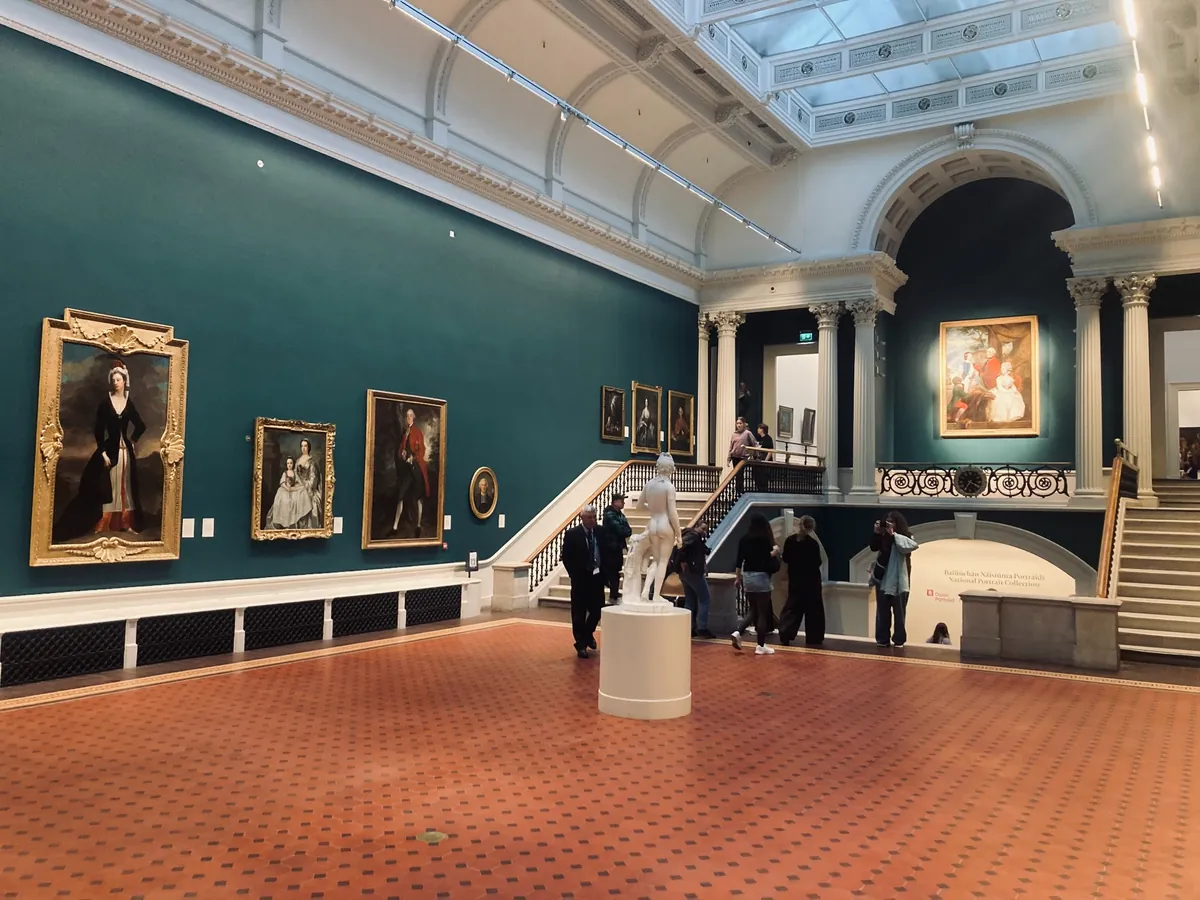
Tip: If you are in the gallery on a Thursday or Sunday, enquire when a very famous painting, The Meeting on the Turret Stairs (1864) by Frederic William Burton, is open to the public. To preserve it, it is only open for viewing for two hours a week (Thursday 11.30am–12.30pm and Sunday 2pm–3pm), but is very touching and was voted Ireland’s favourite painting.
The gallery route
Renaissance and Baroque Art on the Upper Floor
The third floor contains many of the oldest paintings in the National Gallery, including works from the Renaissance and Baroque periods, many of which have religious subjects, depicting scenes from the Bible, the lives of saints and important events in Christian history. If you turn right as you enter from the lift, you can walk down and see beautiful artworks by Dutch painters including Rembrandt van Rijn and Johannes Vermeer. One of the most important paintings in the National Gallery is Vermeer's Woman Writing a Letter, with her Maid, completed around 1670–1671, which featured in the recent major exhibition of Vermeer’s work at the Rijksmuseum in 2023. The painting shows a woman seated at a table writing a letter, while her maid stands beside a window looking out into the distance, and although the painting appears peaceful, the discarded papers and the different expressions of the women suggest that the letter may be connected to a more complicated story.
I usually walk back and go into the end room which contains the famous work Kitchen Maid with the Supper at Emmaus, painted by the Spanish artist Diego Velázquez around 1617–1618. Velázquez was one of Spain's greatest painters and later became court painter to King Philip IV and this painting is considered one of his earliest known works, completed while he was still working in Seville.
If you then walk up the steps in the room, you enter the room with one of the gallery’s most famous artworks, The Taking of Christ by the Italian artist Caravaggio completed in 1602. The painting depicts the moment when Judas betrays Jesus Christ with a kiss, allowing the soldiers to identify and arrest him in the Garden of Gethsemane, and many believe the man holding the lantern is a self-portrait of the artist. The painting has an interesting history, as it was believed to have been lost but was rediscovered in a Jesuit residence in Dublin in the early 1990s, where it had been hanging for many years without its identity being known.
As you turn right from that room, you can walk through a series of galleries containing earlier European art, including Renaissance paintings from Italy and Northern Europe, with works by famous artists such as El Greco, Titian, Tintoretto and Perugino. Many of the paintings have religious subjects, and it is interesting to see how the artistic styles developed over the centuries, particularly in the use of colour, perspective and the representation of people. There are also some beautiful early Christian paintings and religious icons in the adjoining rooms. Sometimes there is an exhibition in the Sir Hugh Lane Room at the end of the corridor to the right, which can be an interesting finish to your tour.
Once you make your way down, after stopping at the café and gift shop, you can exit onto Clare Street and continue towards the shopping and dining areas around Dawson Street and Grafton Street, or a stroll to see Trinity College.
I have only included photographs of the gallery's building and architecture in this article, rather than individual artworks, to respect the National Gallery of Ireland's photography and image-use guidelines. There are so many beautiful paintings to see, and I would highly recommend visiting to appreciate them in person.
All photographs in this article are original photographs © wordsfortravel.
The National Gallery of Ireland is a very walkable and interesting gallery, with plenty of world class paintings by some of Europe’s finest artists, and is well worth spending 2-3 hours relaxing in and enjoying the art. I hope you get some great photos!
Share this guide
Know someone planning a visit to Dublin? Send them this guide.
KEEP READING
Continue exploring
More travel stories and practical guides from Words for Travel.